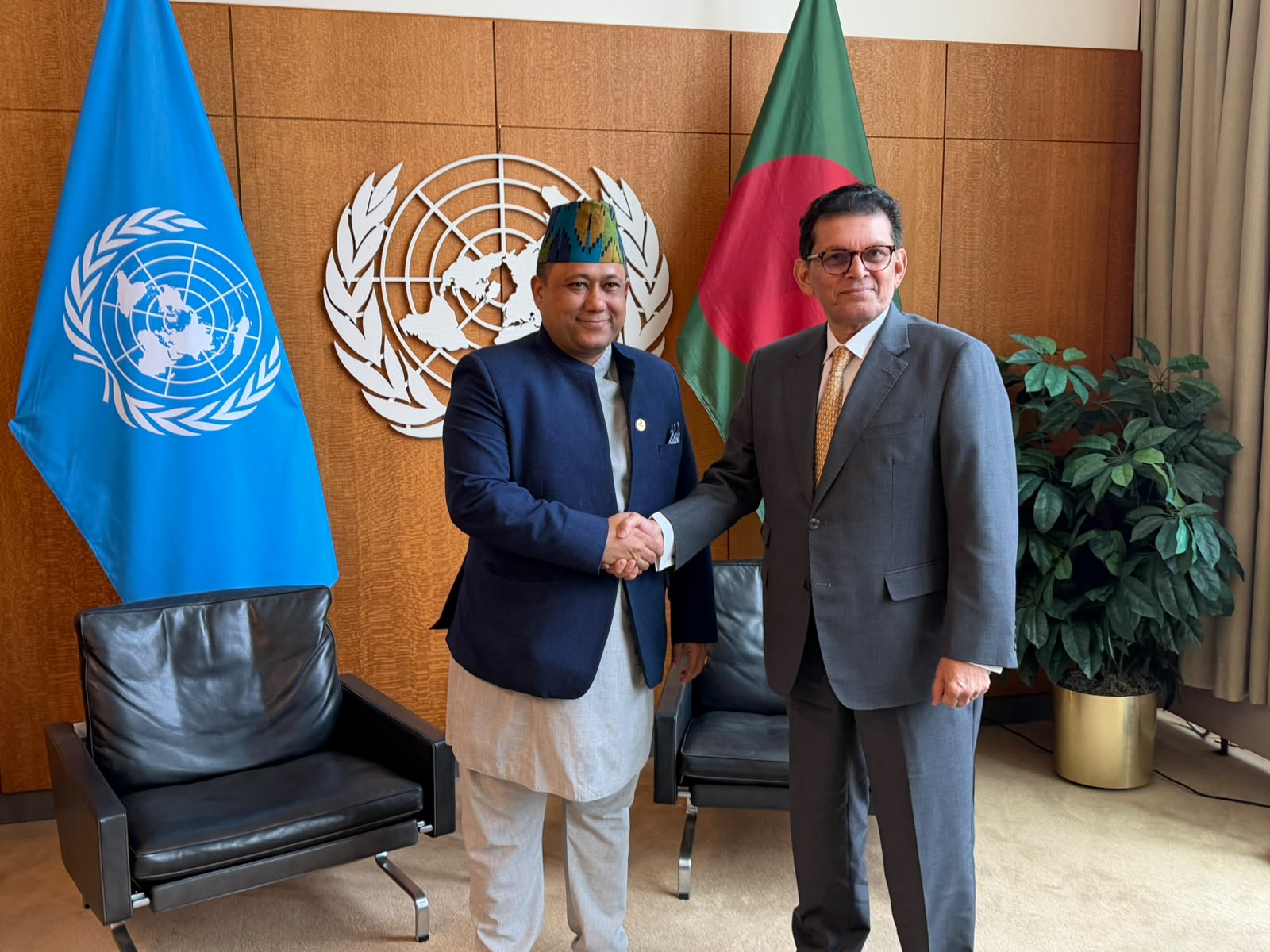
Prime Minister Balendra Shah Addresses UN General Assembly
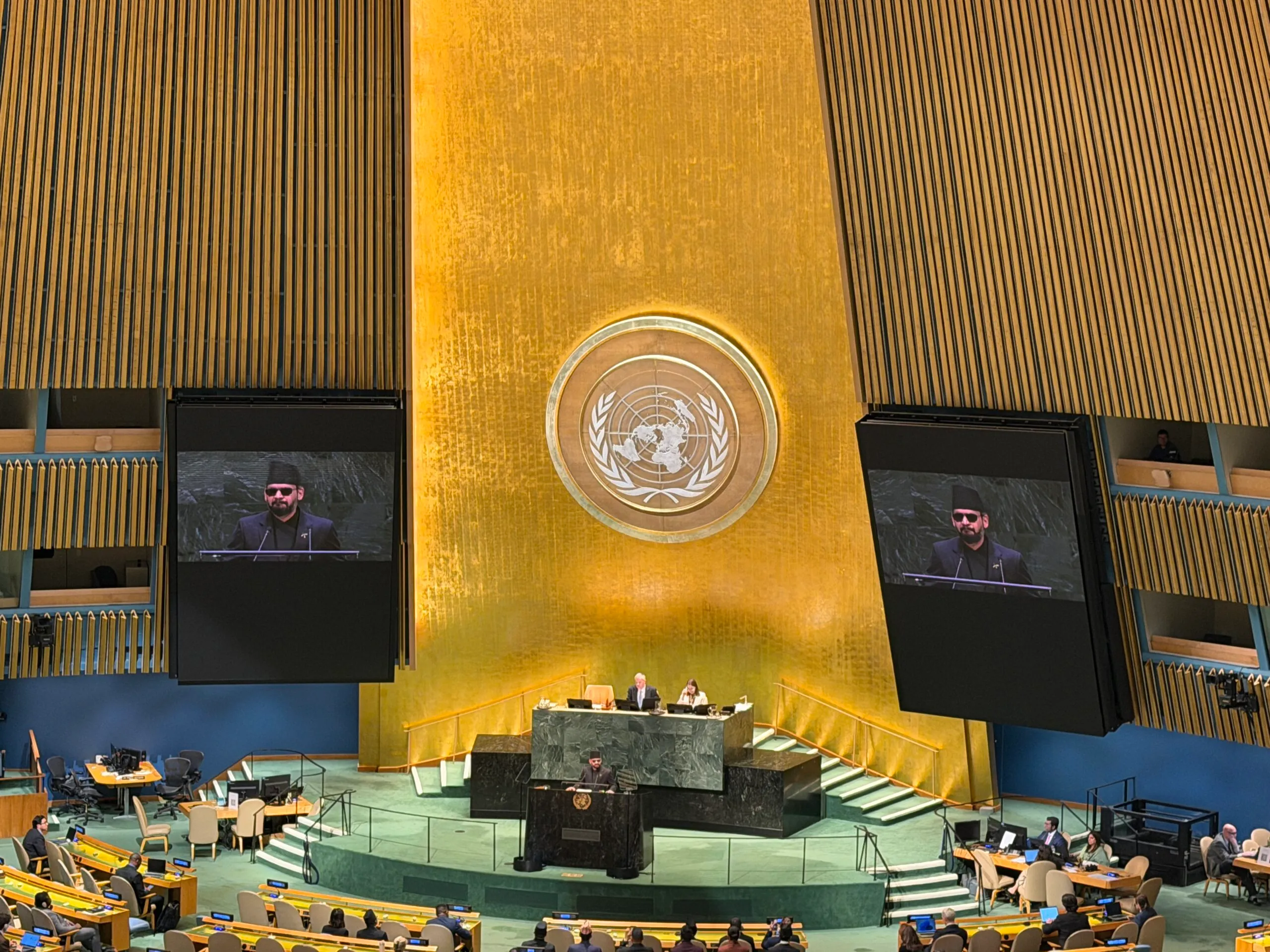
New York: Prime Minister of Nepal, Balendra Shah addressed the 81st session of the United Nations General Assembly on Thursday 8 pm . During the occasion, he urged the global community to take climate change seriously.
Prime Minister Shah raised the issue of the devastation faced by countries like Nepal due to climate change and the responsibility the global community must bear. Presenting the devastation caused by the ‘Tsunami of the Himalayas’ to the global community, he warned that if the climate crisis is ignored, human civilization will have to pay a heavy price.
Prime Minister Shah urged world leaders to focus resources spent on war and weapons on humanity, development, and food security.
He proposed the establishment of a ‘Himalaya Climate Resilience Mechanism’ involving Nepal, India, and China for the security of the Himalayan region.
Full Text of the Address
Mr. President, Mr. Secretary-General, Your Excellencies Ambassadors and Representatives, Ladies and Gentlemen,
I stand before you today from Nepal, a distant country nestled in the lap of the Himalayas, carrying a near-term warning for humanity. I wish I could speak today only about development, democracy, peace, and the aspirations of a young nation. But instead, I must speak of immense destruction and death, of families waiting for loved ones who will never return, of communities searching for the bodies of their relatives in mud, stones, and water, whose bodies may never be found.
I must speak of bridges, roads, schools, homes, and livelihoods washed away in minutes. The progress of my country, on its journey to achieve the Sustainable Development Goals, has been halted.
Four weeks ago, the world witnessed the shocking scenes of a devastating flood that swept away communities in Nepal, which many have called the ‘Tsunami of the Himalayas’. This disaster on the Trishuli was not just a local tragedy. It was a warning to the world, and today I ask you, have we truly heard that warning? Nearly three years ago, standing in the shadow of our Mount Everest, the Secretary-General of the United Nations warned humanity about the madness of climate change and the impending disaster. That voice from the world’s highest peak was not heard sufficiently. We heard it in Nepal, our communities heard it, scientists around the world heard it. They reiterated it with evidence. But we, the political leaders, have been negligent in translating those warnings into action with the speed and scale that sensitive people would desire.
Last month, we saw the tragic consequences. The warming climate is destabilizing the fragile ecosystem of the Himalayas, melting permafrost that bursts glacial lakes, increasing the risk of avalanches, floods, landslides, and other flash floods. Its devastating impact was seen on both sides of the Nepal-China border. The flood reached India downstream. This teaches us one fundamental thing. Climate change knows no borders. Glaciers and floods do not carry passports and visas.
Your Excellencies, I have not come here to complain, but to share some suggestions. First, on behalf of Nepal, I express deep gratitude to all who came forward to help during the time of disaster. Our neighboring countries, India and China, provided immediate and generous assistance. Other friendly nations, the United Nations system, humanitarian organizations, philanthropic organizations, and people from all over the world stood with Nepal. To all of them, I say thank you on behalf of the people of Nepal.
Nepal is now faced with the immense task of recovery and reconstruction. With at least 1400 deaths and over 6,000 people missing, the preliminary assessment suggests that physical recovery will require about 10 percent of the Gross Domestic Product (GDP). As after the 2015 Gorkha earthquake, we expect your solidarity and support. But we must understand why this disaster is also a concern beyond Nepal. Nepal contributes less than 0.1 percent of the world’s total greenhouse gas emissions. We did not cause this crisis, yet we are paying a heavy price for it. Our glaciers are retreating, mountain slopes are becoming unstable, rivers are becoming unpredictable, and every major disaster threatens to erase years of our development efforts.
For Nepal, climate disaster is not just a humanitarian event, it is a development crisis. It destroys roads, bridges, schools, homes, fields, and livelihoods. It destroys the infrastructure for clean energy that we need for the future. And it forces poor countries to take on debt to repair damage they did not cause. But we have not come here to blame any country or continent. We have not come here to urge any country to turn climate change into another geopolitical battlefield. We have come here to urge everyone to recommit to shared responsibility and solidarity.
Through the United Nations Framework Convention on Climate Change (UNFCCC), the international community has already agreed on the principle of ‘common but differentiated responsibilities’. Those who have historically contributed more to the problem and have greater capacity to respond must do more. Climate justice cannot remain just a beautiful phrase in a UN document. The people of our country must be allowed to build a future, rather than constantly rebuilding their past.
Your Excellencies, the Hindu-Kush Himalayas are home to nearly two billion people. These mountains provide water, ecosystems, agriculture, and livelihoods to populations far beyond Nepal. The Himalayas are not a fringe of the planet; they are an integral part of the Earth’s life support system. Therefore, as an immediate first step, we propose the establishment of a ‘Himalaya Climate Resilience Mechanism’ led by Nepal, India, and China. Through this mechanism, let us share satellite data and expertise. Let us monitor dangerous glacial lakes, strengthen joint early warning systems, and when disaster strikes, coordinate cross-border assistance. Let the Himalayas be a laboratory for international cooperation, not a border of scattered information.
Remarkably for a Least Developed Country, Nepal is playing a global role beyond its ecological footprint. We have restored forests in nearly half of our territory. We are rapidly increasing hydropower generation to meet our clean energy needs and displace fossil fuel sources abroad. We are promoting electric vehicles at a rate comparable to some parts of Europe. We are strengthening local climate adaptation and will make further efforts to cope with the increasing intensity and frequency of climate disasters. But Nepal alone cannot build resilience against this crisis caused by the failure of global governance.
Therefore, this assembly must focus on six words: relief, rehabilitation, reconstruction, and along with them, responsibility, compensation, resilience. The first three are needed after a disaster. The latter three are necessary to prevent disasters from becoming permanent. When climate-induced disasters destroy the infrastructure of poor countries, the response cannot be just another large loan or a patchwork of small grants. We need sufficient grant-based support from the world. The Loss and Damage Fund, the Global Environment Facility, and other financial mechanisms are insufficient. Climate finance must not become a bureaucratic labyrinth where vulnerable countries spend years seeking assistance. When a house is on fire, we don’t make the family fill out 50 forms; we take action. This is what climate justice should mean.
Your Excellencies, this brings me to a larger question. What kind of international order do you want? The United Nations was born out of the human experience of a terrible world war. Its promise was that sovereignty matters, international law matters, the dignity of every human being matters, and that the weak should not have to accept whatever the powerful dictate. Today, that international system is under pressure. Too often, military and economic power determines whose voice is heard and whose war matters. Nepal believes that we need a more equitable global economic order.
In 1994, the UNDP’s Human Development Report conceptualized ‘human insecurity’. It linked security to people rather than territory, and to development rather than arms. It called for a ‘Peace Dividend’ to ensure freedom from fear and want. Nepal’s new majority government, elected through the most equitable and peaceful election in our history this March, has faced many international adversities. When a poor peasant woman in Nepal tried to sow seeds in the monsoon, fertilizer did not arrive on time. When we wanted to pay for a new highway, there was no money.
Poor people are punished for things beyond their control. Intercontinental missiles arrive on time, rifles and ammunition cross borders, overcoming all obstacles, meeting every deadline. But a farmer in Nepal cannot get fertilizer or fuel at market price when needed. We have created a world with a flawless logistics system for war and a broken one for food. And this is not just Nepal’s misfortune. Ask Bangladesh, ask Bhutan, ask India, ask Maldives, ask Pakistan, ask Sri Lanka, ask any country in our region, and you will hear the same story. We are victims of climate change that we did not start, and wars that we did not start. This teaches us that much more is broken in global cooperation than meets the eye.
Your Excellencies, I have been told that I am the youngest head of government to address this assembly this year. I have not come to make a story out of that. I have come to ensure that whatever is said from this platform, one thing is made clear: a country willing to pay the price should be able to buy, and a world that can deliver weapons anywhere in 72 hours has no excuse not to provide a farmer with the means of livelihood. That is why we believe in multilateralism. That is why we need a United Nations where the presence of a small poor country is felt, and we can walk towards results together. That is why climate justice is not just about money. It is about distributive justice: who bears the cost? It is about procedural justice: whose voice is heard? It is about whether mountain communities, small island nations, landlocked and least developed countries, and future generations are counted equally. Nepal is ready to lead this dialogue from the ‘Sagarmatha to Seaside’ program, which will be held at the UN itself tomorrow.
Mr. President and Your Excellencies, we stand at this General Assembly at a moment of deep global uncertainty and with the aspirations of a new generation reflected in a new democratic mandate. Our youth have demanded politics of honesty and accountability. This generational change is not just a national narrative. It is part of a global awakening against conflict, inequality, and lack of opportunity. My government’s commitment is clear: to build a state that provides dignified employment, social security, and a fair opportunity for every Nepali to thrive at home.
The floods in Nepal have signaled a future shaped by climate extremes. Our basic systems are no longer relevant, and we must move from ad hoc responses to a culture of preparedness. Let us finance resilience and invest in insurance and innovation. Let us build strong infrastructure and institutions. Let us reduce dependence on fossil fuels. Let us build systems that warn, alert, and save lives. Let us reform systems that give the least power to the most vulnerable. And when another warning comes from the world’s highest peak, let us be ready to hear it and ready to act.
May Lord Pashupatinath bless the world. May this world walk on the path shown by the Buddha. Thank you very much. Namaste.